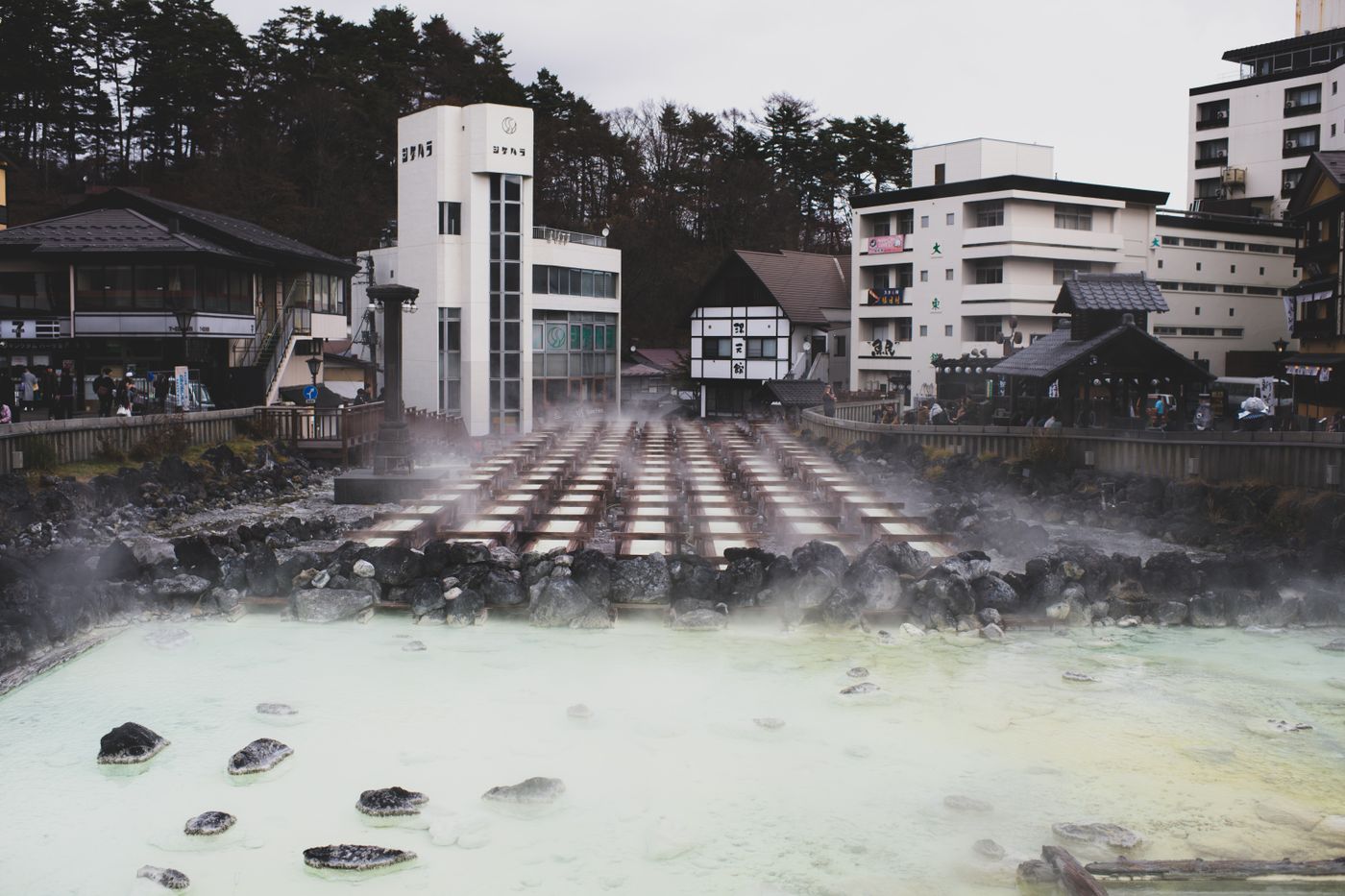
The model plan
Base Start at the Yubatake, Kusatsu's steaming turquoise hot-water field in the centre of town — the landmark everything else radiates from.
The loop Work through the three public baths: Goza-no-yu by the Yubatake, the big indoor wooden baths of Otaki-no-yu, and the open-air Sainokawara Rotenburo in Sainokawara Park. Buy the three-bath pass at the first one and keep it for the rest of the loop — it never expires, so an unfinished loop can wait for your next trip.
| Item | Indicative cost |
|---|---|
| Otaki-no-yu (per person) | ¥1,200 |
| Goza-no-yu (per person) | ¥900 |
| Sainokawara Rotenburo (per person) | ¥800 |
| All three bought separately | ¥2,900 |
| Three-bath pass (no expiry) | ¥2,100 |
The tattoo policy, in the operator's own words
All three public baths publish the same FAQ answer on their official pages. In the operator's framing, the baths do not particularly refuse entry or bathing to people with tattoos, and they welcome guests of diverse cultural backgrounds — provided normal bathing manners are followed.
Read that wording honestly: it is an official non-refusal, which puts Kusatsu well ahead of the many towns that publish nothing at all, but it is not the blanket town-wide guarantee you get in Kinosaki. It also has a clear boundary — the statement covers the three public day baths. Individual ryokan in Kusatsu set their own rules for their in-house baths, so a tattooed guest soaking at their inn needs to ask that inn. As outside corroboration, the Japan National Tourism Organization (JNTO) includes Otaki-no-yu in its official list of tattoo-friendly onsen in Japan.
What to know before you go
We do not yet have review evidence for Kusatsu that we can summarise responsibly, so instead of visitor quotes, here are the practical caveats from the official sources:
The condition attached is manners. The FAQ's welcome is explicitly tied to following normal bathing manners — wash before entering, no towels in the water, keep the changing room and baths orderly. That is standard onsen etiquette everywhere, but in Kusatsu it is written into the tattoo answer itself.
Public baths ≠ your inn. The three public baths are the safe route. If your plan centres on your ryokan's own bath, confirm its rule in writing before booking, and ask about reservable private baths as a fallback.
Policies change. These pages carry a November 2026 check date for a reason. If you have large pieces and a long trip riding on it, a quick confirmation with the facility before you travel is cheap insurance.
Where to stay
Most visitors stay in a ryokan or hotel around the Yubatake and walk to the public baths. Because each inn sets its own tattoo rule for its in-house baths, the public-bath policy on this page does not tell you whether you can soak where you sleep — check the inn's own policy, or plan to do your bathing at the three public baths and treat the inn bath as a bonus. We list no prices here because we have not verified current Kusatsu room rates for this guide; check the booking page figures against the inn before you commit.
Access from Tokyo
- Direct bus (easiest): JR Bus "Joshu Yumeguri" highway buses run from Busta Shinjuku, Tokyo Station and Ueno straight to the Kusatsu Onsen Bus Terminal — about 4 hours, ¥3,700–4,000, reserved seats, no changes.
- Train + bus (fastest): Limited Express Kusatsu-Shima from Ueno to Naganohara-Kusatsuguchi (about 2 hours 33 minutes), then a JR bus of about 25 minutes (¥780) to the Kusatsu Onsen Bus Terminal — roughly 3 to 3¼ hours in total.
- Kusatsu has no railway station of its own; every route ends on a bus.
FAQ
Are tattoos allowed in Kusatsu's public baths?
The operator's FAQ says the three public baths do not particularly refuse entry or bathing to people with tattoos, provided normal bathing manners are followed. It is an official non-refusal covering the public baths only.
Which baths does the policy cover?
Otaki-no-yu (¥1,200), Goza-no-yu (¥900) and Sainokawara Rotenburo (¥800) — the same FAQ text appears on all three official pages. Ryokan baths are not covered.
Is the three-bath pass worth it?
Yes if you will visit all three: ¥2,100 against ¥2,900 bought separately, and it has no expiry date.
Can I bathe at my ryokan in Kusatsu with tattoos?
Ask the inn — individual ryokan set their own rules, and the public-bath policy does not extend to them.
Sources checked 7 November 2026: the operator's official FAQ pages for the three public baths (onsen-kusatsu.com — Goza-no-yu, Sainokawara and Otaki-no-yu FAQ pages, which carry identical tattoo wording) for the policy and prices; JNTO's official "7 tattoo-friendly onsen in Japan" story, which names Otaki-no-yu. Opening hours are not listed because we could not verify them against an official source in this pass — check the baths' official sites before you travel. Access times and fares were cross-checked on 7 November 2026 against JR Bus Kanto route information and current route guides based on the Kusatsu Onsen Tourism Association's access guidance. Policies change; confirm with the facility if your trip depends on it.